About This Blog

The purpose of my blog is mostly for review, film analysis, and other posts relating to popular culture. I always love to entertain and love to share the wonderful things I see. Join me on a journey through my life and the world
Showing posts with label Trump. Show all posts

Friday, May 15, 2026

The Iranian Revolutionary Guard Corps: An Overview

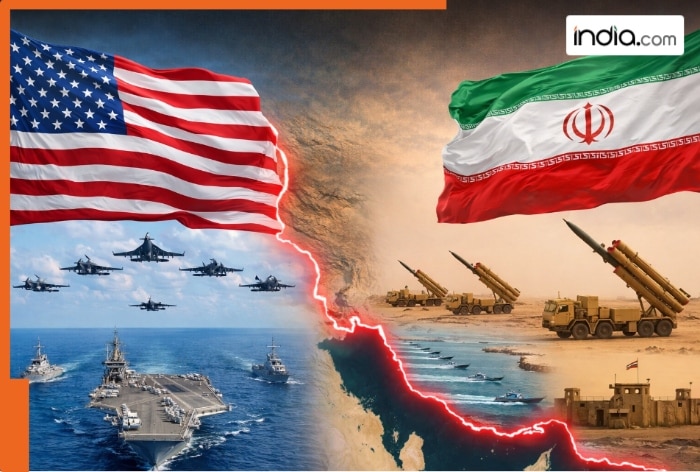
With the President’s decision to start a war with Iran, I thought it would be a good idea to get a book on the Islamic Revolutionary Guard Corps (IRGC), the military that seems to be running the Iranian Government.  Fortunately, Amazon didn’t disappoint as they had a book readily available.  That 2023 book was “The Iranian Revolutionary Guard Corps: Defining Iran’s Military Doctrine.”  The book gave me an overview on the Corps’ history, military tactics, purpose, and overall impact on the region.

Now, the book itself isn’t a thorough history book or overview of the IRGC itself.  Rather, it serves mostly as a literature review of other writings on the military force and a general background on them.  It wasn’t super in-depth, but I enjoyed it as someone unfamiliar with the IRGC because it served as a primer for understanding them and their relation to US policy.  So, I’ll be giving an overview of its contents as I’m hoping that may help others understand it and the current war as well.

To start off on its history, the IRGC was created by Iran’s former Supreme Leader, Ruhollah Khomeini, as a paramilitary organization to defend the revolution that brought him to power and ousted the Shah.  Its primary focus was purging institutions, especially the military, of elements disloyal to the 1979 Iranian Revolution and enforcing edicts passed by the country's leaders.  Over time though, its role greatly expanded as it ended up supplanting the country’s military, the Artesh, and controlling the country itself.

During the Iran-Iraq War, the IRGC saw its role greatly expand in defending the country against the invading forces of Saddam Hussein.  Shortly after that, the death of Supreme Leader Khomeini resulted in his replacement by Ali Khamenei.  According to the book, the IRGC helped with his rise to power and he, in turn, greatly expanded their power in the country.

With the IRGC serving as the institution defending Khamenei’s reign, it played a key role in keeping the government in check.  Almost every President elected in the 90s up until the mid 2000s was a reformer, and the IRGC opposed every attempt at reform.  It sent orders to the President, put down protests, and worked to make sure its own people were constantly in control or running the government.

Then, in 2005, it helped get hardliner and Mayor of Tehran Mahmoud Ahmadinejad elected President.  Despite not being seen as an intellectual heavyweight, Ahmadinejad did continue on his predecessor’s push to privatize the country’s economy.  Unfortunately, Ahmadinejad had a bunch of the government’s companies sold to people with ties to the IRGC, which was not the point of privatization.  So after that, the IRGC started to control the economy and thus the country at large.  The only thing worth consideration is that Ahmadinejad’s successor also attempted reform, and failed, so the history of Iran’s civilian government is to try and fail to reform what is now a military dictatorship.

Now, going back to the Iranian Revolution, the book also chronicles failures in the US to actually address Iran throughout its history.  Specifically, back during the Shah’s reign, Jimmy Carter wavered in his support for the Shah which Khomeini used as justification to return to Iran and that lack of confidence led to the Shah’s overthrow.  The Reagan Administration was equally inconsistent as it on one hand supported Saddam’s war with Iran, and then sold weapons to Iran to fund a war in Nicaragua.

After that, the next three US Presidents, H.W. Bush, Clinton, and W. Bush didn’t really have much of an Iran policy as they all became focused on Iraq.  In the vacuum that was created by Saddam’s removal though, Iran started greatly expanding its military network into Iraq and improving economic ties with them.  So the US didn’t have a consistent policy on Iran until the 2010s, and its actions greatly helped Iran expand its influence in the region.

The book then discussed Obama’s policy of negotiation with the Iranian government and the 2015 deal that was struck and Trump’s decision to withdraw.  The book tended to lean more in favor of Obama’s approach, which is why it notes more flaws in Trump’s proposal like how they started building more centrifuges after the US withdrew from the deal.  The withdrawal was also used by the IRGC to portray weakness by President Rouhani and justify curtailing his attempts at reform.  In short, the US hasn’t had a serious approach towards Iran until 2015 and now we are in the midst of a war with them.

Of note, the book also discussed the IRGC’s approach towards war.  Specifically, they support an emerging tactic known as “Hybrid War” which is still being defined.  The idea is that the IRGC uses a combination of military tactics including conventional war, guerilla war, terrorism, and cyberwarfare to complete its military objectives.  It also supports militias and paramilitary organizations in other countries such as Iraq and the Houthis accomplish its goals internationally.  So it’s not fighting a traditional enemy as they’ll support whoever or whatever to accomplish their military objectives.  As a result, a conventional war is not what’s going to take them down.

Finally, the book discusses what that means for future negotiations and handling Iran BEFORE the US’s invasion which took out Khamenei.  It did have some key points such as that Iran would never abandon its missile program so the focus should instead be on addressing its nuclear program.  It also notes that Islam is, ironically, becoming less of a focus for the IRGC as they become increasingly focused on controlling and maintaining the government.  Similarly, they would prevent the government from doing anything without their approval which meant any actual negotiations would not be possible without their approval so they would be a key roadblock to any meaningful negotiations.  A lot of this is irrelevant now that we are at war and Khamenei is dead, but there is one point that remains clear: the IRGC is the main power in the country, they have no intention of doing anything the reduces their power, and a lot of what they want is at odds with the US’s objectives in the region and the country.

I’m not posting this not to say I agree with every tenant of the book, but more to give a brief overview of it.  A lot of this does explain how we got to where we are, what’s going on now, and what we can expect after the war.  For that reason, I recommend giving the book a read.

Tuesday, May 12, 2026

The Future of the Political Parties

 What are the differences between Democrats and Republicans? A guide to ...

A previous blogpost dealt with the future of the Republican Party under Donald Trump.


However, that same post left off asking what that would mean for the party as a whole.  Well to steal a line from Captain Barbossa, the parties are to “be two immortals locked in an epic battle until Judgment Day and trumpets sound”.  However, that doesn’t necessarily mean that the parties will be tomorrow what they are today.  In fact, I predict that, based on personal experience, the parties will actually grow to reflect each other over time while the differences become more regional than ideological.


It’s a bit of a cliche to talk about how divided American society is now.  A Gallup poll shows that the political parties are more ideologically divided now than before.  More interesting though is that the parties are also extremely divided along territorial lines with the Democrats dominating the cities and the Republicans dominating the countryside.


Another interesting trend is that many people are fleeing blue states in favor of red ones.  After all, blue states lost more congressional representatives in the last census while red states picked them up.  One could claim that’s irrelevant in the grand scheme of things as once red states like Georgia and Arizona are now purple, but, on the flip side, purple states like Ohio, Iowa, and Florida have been voting Republican more consistently these days.  So there is a growing territorial reshuffling of where the national power center is and that’s likely to continue.


So it’s likely that people are splintering into areas where people are closer to their political beliefs or, at least, not in favor of policies that hold their states’ economic growth back.  However, elections in the U.S. are run by states, not landmasses.  There are still decent sized enclaves of Republicans in blue states and Democrats in red states.  So, what happens to them as their states become more ideologically captured by either party?


Well, I was knocking doors for Michelle Davis last month during the campaign and some conversations I had may provide the answer.  There were several anti-Trump homes that told me they were voting in the primary just to stop Michelle from winning because she was endorsed by the President.  With Indiana having a Republican supermajority in the legislature and no statewide elected official that’s affiliated with the Democrats, it seems these voters believed it was better to vote in the Republican primary, which is legal since Indiana has a functionally open primary system, to get a more moderate or anti-Trump candidate since the Democratic is unlikely to win regardless of the nominee.


One could make fun of Indiana for being a one party state, but that’s true for other regions as well.  I knew people who lived in Chicago who simply didn’t vote there because Dems always won so voting there was a waste of time.  I had the same experience in Bloomington, Indiana because the conventional wisdom was that Republicans never win so it was always better to run as a Democrat.  Point is, everyone knows a region that’s essentially a one-party state and current redistricting battles are making more of them.


Which brings us back to the Greg Walker voters I was talking to that were voting just to oppose Donald Trump.  Honestly, it’s likely that may become a more likely phenomenon as the states become increasingly captured by their respective parties.  It’s possible that more voters may find themselves joining or running in parties they don’t necessarily connect with because that’s what party is in control in their area.  After all, there is no way to have influence without being involved in the community, and if you aren’t part of the local party, it’s harder to influence politicians.


With the growing regional divide, that likely may determine what the parties look like going forward.  It may no longer be conservative vs. liberal or libertarian vs progressive, but rural vs urban or south vs west coast.  Ironically, this may lead to more moderate candidates and decreased ideological polarization because it means the candidates will need to balance out the new factions in the party.  So there would be less ideological divides, but more regional divides instead.


Now I’m going to wrap this up by acknowledging that I’m not very good at making predictions.  After all, if I was then Bob Iger wouldn’t have returned as Disney’s CEO and Pete Buttigieg would have been the Dem nominee 2020.  However, I do notice trends so discussing possible consequences of those trends is still worth considering.  After all, one of my predictions may not come true, but that doesn’t mean a different possibility I haven’t thought of may address the reasons behind it.


However, with growing pushes to make it harder to vote for political opponents to win going forward, from redistricting to making Indiana a closed primary state, joining the dominant party may be the only way to be engaged in politics locally or higher.  With Republicans enjoying a slight advantage in terms of registration, that would definitely bode well for them nationally.


So will this be the future of the party or will something else happen entirely?  Only time will tell.  However, never forget that many of the state senators that got primaried last week had been in the state senate for decades.  It will be interesting to see who’s still in office in 20 years.


Premium Photo | Washington dc capitol building at night usa congress ...

Thursday, April 30, 2026

What the Heck is Going on at the Pentagon?

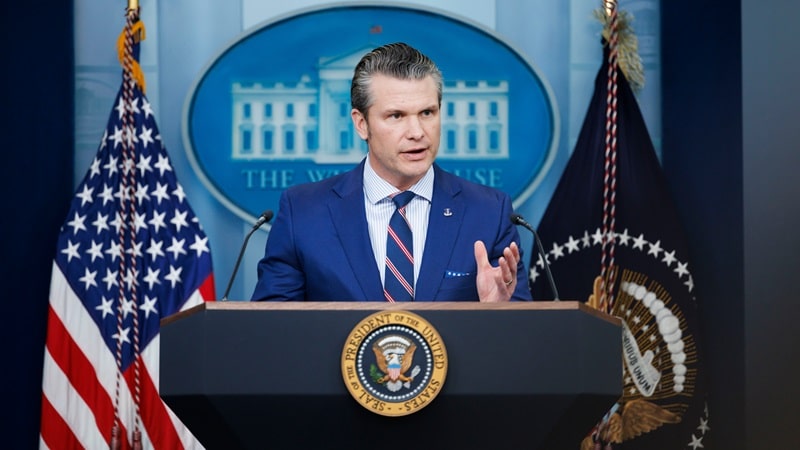
Strange things are going on at the Pentagon.  That’s hardly surprising knowing the U.S. government, but the actions taken under Secretary of War Pete Hegseth have been confounding.  I could mention the fact that the Pentagon is now soliciting car manufacturers to start building weapons, or I could mention how much they were spending on lobster, but neither is the point of this blogpost.  No, the purpose of this blogpost is to discuss the strange religious news that keeps coming from the US’s military.

Most prominently, there was an announcement of lawsuits claiming that various military commanders were saying that Trump had been anointed by God to start Armageddon by invading Iran.  Those who have studied the book of Revelation would know that that’s not how the apocalypse works, and the lack of magisterial sanctioning should be more than enough cause for its rejection.  However this was not the only strange spiritual statement coming from the Pentagon.

This year, Hegseth also had a pastor lead a worship service at the Pentagon, and that same pastor later called for bans on Eucharistic processions for being idolatry.  Also, Pete Hegseth quoted a Bible verse from Pulp Fiction that was only based on a verse from the book of Ezekiel.  So there seems to be a recurring theme of religious fervor at the Pentagon, but none of it is based on a sound foundation.

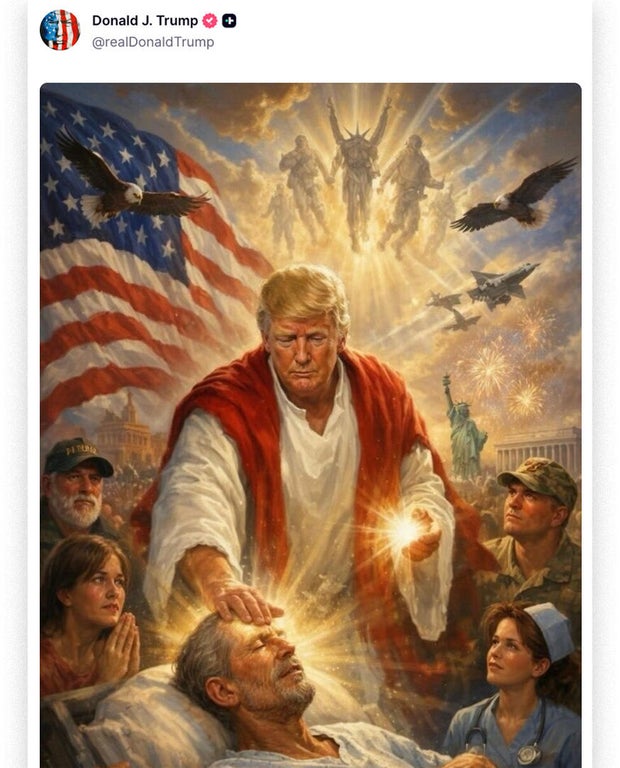
It would be easier if this could be blamed purely on one cabinet official, but this has expanded beyond the War Department.  For whatever reason, the President decided to post an image of himself as Jesus on social media, and his senior advisor to the White House Faith Office once said “saying no to Trump would be saying no to God.”  So there is a growing spirituality in the White House that seems to idolize the President.

One could wonder why these events are happening.  It’s possible that we may be living in a country where the leader believes himself to be a God, but he has denied as much and claimed the Jesus image was an accident so there’s no direct evidence of that.  It would be easy to write this off as a self-serving manipulation of scripture to serve his agenda, but the line between fanaticism and selfishness has traditionally been a very confusing one.  It’s possible then that there is some genuine attempt at spirituality, though a tragically misguided one.

After all, there has been discussion of the President’s spirituality.  Former Archbishop of New York Cardinal Timothy Dolan once said that Trump takes his faith seriously.  Similarly, the President had created a religious freedom board that included multiple prominent bishops, including Bishop Barron, who has both worked with and opposed him at times, and Bishop Kevin C. Rhoades, whose diocese is one of the few in the U.S. that is providing new priests above replacement.  So it’s not as simple to write this off as completely disingenuous unless we doubt the sincerity of these bishops as well.

Also, there are members of his administration who have been outwardly religious and yet not in a self-serving way.  Secretary of Health and Human Services Robert Kennedy Jr. once said before getting his position that he prays 30 minutes a day.  Similarly, JD Vance converted to Catholicism long before running for senate.  He’s had his contentions with the church, such as his spat with Pope Francis, yet he met with the pope shortly before his passing and has apologized for other spats.  So there is a case that there is sincerity in the faith of these men.

So that does beg the question then as to what might be motivating these strange actions from Washington.  Well, I’m not talking to these people so I couldn’t guess what’s in their hearts.  Still, these have been strange actions indeed and it should cause concern for the average Christian.

Now, before leaving, I’m going to leave advice when navigating these troubled times.  First of all, the book of Psalms warns “Put not your trust in princes, in a son of man, in whom there is no help.”  All humans are fallible and prone to sin, so putting them as the center of salvation inevitably ends in destruction.  It’s why we need to trust in God above all things.

Second, St. Faustina once wrote that “Satan can even clothe himself in a cloak of humility, but he does not know how to wear the cloak of obedience.” Whatever is said by anyone, a person must always be in obedience to God’s will first and foremost.  When they reject it, it will usually reveal evil and for that reason must be ignored.

Finally, Proverbs 19:21 states “Many are the plans in the mind of a man, but it is the purpose of the Lord that will be established.”  Whatever we choose to put our support behind, it is God’s  Will that we must prioritize.  So when choosing which side to be on, we should always do our best to prioritize that.  If we abide by those three rules, I think we’ll turn out alright.


Wednesday, February 25, 2026

Is Marco Rubio Running the White House?

The headline is extremely clickbaity, but it’s a question that might be worth asking.  Since being confirmed as Secretary of State, Marco Rubio has been heavily involved in some of the most important international political events of the still developing 21st century, and his influence only seems to be expanding with each passing day as more situations globally keep developing.  It might be worth investigating how much influence he has, then, and how his role continues to develop.

So to start off with, a little background on Marco Rubio.  Elected to the U.S. Senate in 2010, Rubio would go on to serve on the Senate Committee on Intelligence (where he was the acting chair and then ranking member) and the Committee on Foreign Relations.  He also served on the Committee on Appropriations, which, while not directly dealing with foreign affairs, does have full jurisdiction over all discretionary spending and military spending constitutes 56% of the federal discretionary budget.  So he was very heavily influential in government legislative committees that focused on foreign and military affairs.

Of note, he had a particularly prominent history of supporting military intervention in foreign affairs.  In the senate, he supported the overthrow of Muammar Gaddafi in Libya, supported giving ammunition to Syrian rebels during the civil war under Bashar al-Assad, pushed against establishing diplomatic ties with Cuba during the Obama administration, called for revolution in Venezuela and met with an opposition leader that was accused of attempting a coup by the Maduro government, supported increased military ties with China’s neighbors (and enemies), etc.  Of note, during the 2016 presidential primaries, he was the candidate who called for use of military force third most out of all of them according to the CATO institute (Trump was dead in the center between most calls and least calls).  So he has a history of wanting to use military force to accomplish America’s foreign policy objectives.

This is noticeable because since he’s become Secretary of State and National Security Advisor (the first to hold both positions at the same time since Henry Kissinger back in the 70s), the Trump administration has taken a noticeably more hawkish tone since its first term.  Similarly, many of Rubio’s policy agendas when he was in the senate have been coming to fruition.  During his tenure as Secretary of State, the US has captured now former Venezuelan President Nicolas Maduro, placed an oil embargo on Cuba while talking about regime change, and placed steeper tariffs on China while pushing stronger military relations with Japan.  In addition, the US has pushed to take Greenland and has created the largest military buildup in the middle east around since the Iraq War due to a growing possibility of war with Iran (a country which Senator Rubio supported sanctions on).  So it seems like much of Rubio’s agenda in the senate is being reflected by the Trump administration.

Now, one could argue that Trump possibly changed his mind during his four years out of the office.  Besides, many of these countries are ones he clashed with during his first term as President.  After all, he did take out the leader of Iran’s Quds force, struck Syria, and recognized Venezuela’s opposition leader as the real head of the country’s government during his first term.  He’s also been a long term critic of China so being strong against them isn’t all that surprising.  Therefore, Trump’s actions are not definitive proof that Rubio is in complete control of the US’s foreign policy.

However, the fact that Rubio is getting most of his foreign policy agenda as a senator made a priority by the current administration does show the impact and influence he is having.  Likewise, he has publicly disagreed with his boss, noticeably when he downplayed military options to take Greenland when Trump refused to rule that out and took a more collaborative tone towards working with Europe than did JD Vance at the Munich Security Conference.  The fact that he is able to push back on those with higher authority than himself when disagreement has led to firing of officials in the past shows that Rubio may be in a safe position.

Similarly, there have been reports about Trump’s dependence on those closest to him.  There was a saying that during Trump’s first term, the last person he spoke with was usually the one he agreed with at the time.  Keeping in mind that Trump had never been elected before, it’s not surprising that he wanted to take advice from people with more experience than himself in the governmental field.  However, Rubio was not a direct member of Trump’s administration during his first term so that means he has a lot more opportunity to influence the President.

The final point to consider is the weakness of Trump’s ability to accomplish his domestic agenda.  Noticeably, Speaker of the House Mike Johnson has struggled to get legislation passed, making an inactivity record, which makes it hard to pass domestic policy since most of that is in the hands of the legislature.  Similarly, a lot of the early policies of the Trump administration was supported by investigations from the Department of Government Efficiency, an initiative championed by Elon Musk.  However, Musk is no longer part of the administration so that initiative seems no longer to be front and center in Trump’s administration.  Increasingly, Trump’s agenda is moving away from what requires congress’s help and is becoming more focused on how he can assert himself internationally.  That means that much of the Trump administration’s second term will be defined by Marco Rubio.

In fairness, there’s a saying that leadership is about getting the right people in the right positions.  If Rubio is directing the White House’s current agendas, then that isn’t a statement of weakness on the President since his goal is to lead the executive branch and make sure the right people are doing the job he requires of them.  However, this blog post should show how much influence Secretary of State Marco Rubio has and how much he can shape the direction of the president.  So it is likely he might be the one actually determining US policy, at least internationally, going forward.  Regardless, whatever his influence, a biography on him will likely be a fascinating read, and a must for anyone who wants to understand US foreign policy in the 21st century.