About This Blog

The purpose of my blog is mostly for review, film analysis, and other posts relating to popular culture. I always love to entertain and love to share the wonderful things I see. Join me on a journey through my life and the world
Showing posts with label Christ. Show all posts

Sunday, May 10, 2026

The Crown of Thorns

Head of Christ Crowned with Thorns Painting by After Guido Reni - Pixels

My spiritual director once told me to do a daily rosary.  In addition, he told me to reflect on each mystery as I did it.  I’ve found myself doing this now for months since then and it has increasingly made me feel closer to God the father, the son, the church, and the Virgin Mary.  However, of all the mysteries that stick out to me the most, the one that I keep coming back to is the crown of thorns.

As it says in the book of Matthew, as Christ was scourged by the Romans during his trial, the Roman soldiers took Jesus and placed a crown of thorns on his head.  The intent was to mock him for his title of “King of the Jews,” a moniker they nailed above his head on his cross.  Yet ironically, since he was the “King of the Universe,” that parody crown became the symbol of Christ’s authority over his subjects: us.

In the Greek and Roman world, crowns were fashioned as wreaths and made out of different plants or flowers and had different representations.  For the Greeks, they were a sign of victory at games, association with religious ceremonies, or for performances.  The symbolism was continued by the Romans, but the wreath eventually became more associated with military accomplishment and powerJulius Caesar himself wore a wreath made of laurels to symbolize his military victories and it was normalized for emperors to wear by his nephew, Caesar Augustus, the first Roman Emperor.  For Christ though, his crown was not made out of laurels, roses, or gold, but instead thorns.  They would have been thick enough to dig into his head and inflict great pain on him as he carried his cross for his crucifixion.

It’s also a fitting symbol for God’s love as it is an inverse of the curse that was inflicted on Adam.  As Adam was being punished for accepting the forbidden fruit “And to Adam he said, ‘Because you have listened to the voice of your wife, and have eaten of the tree of which I commanded you, “You shall not eat of it,” cursed is the ground because of you; in toil you shall eat of it all the days of your life; thorns and thistles it shall bring forth to you; and you shall eat the plants of the field’.”  Many historians and theologians accept Christ’s wearing of the thorns as redemptive for this reason.  On his head, as he is sent to die, he is carrying the pain and weight of those sins, including the original one.

In many ways this is also an inverse of Roman culture and leadership.  In Rome, strength was idolized as the symbol of man’s authority and ability.  The man who committed the most conquests, asserted himself the hardest, and fought the most wars was usually the one who was awarded the highest honors.  Unsurprisingly, 75% died of unnatural and usually violent causes, proving that they were the poster children of the phrase “For all who take the sword will perish by the sword.

APLitWhitman1st: Judgement: Pilates and Jesus

Christ, meanwhile, sacrificed himself for us so that all, Jew or Gentile, slave or free, would be reconciled to God and could be with him when they die.  That action is a reflection of what Christ said in his sermon on the Mount, Blessed are those who are persecuted for righteousness’ sake, for theirs is the kingdom of heaven,” a promise he also makes to the poor in spirit.  So the great King of the earth conquered and redeemed not through violent conflict, assertion of power, or military strategy, but taking on the role of a servant and sacrificing his life.

We are called to imitate that willingness to sacrifice and that humility in service to God, the church, and our fellow man.  To prioritize others and to love them at great cost to ourselves.  That’s why the crown of thorns is such a powerful symbol.  Because it reminds us that our suffering and sacrifices redeem us and our neighbors the same way Christ’s sacrifice redeemed us.

I personally connect with it as well because it is also a symbol of leadership.  Many people imagine positions of power represented the same way the most do: A golden crown representing strength, wealth, pleasantry, or freeness from pain.  In reality, leadership is a sacrifice because of the requirements and responsibilities one has to take as they rise.

A good leader always has to put the wellbeing of the team and the mission above their own needs.  To constantly be deprioritizing themselves and willing to make sacrifices so that whatever project they are working on can be seen to fruition.  Those sacrifices could include longer hours, greater passion, greater financial sacrifices, or simply spending more time with a struggling teammate to help them complete a task.

In addition, the failures of the team are a reflection of the person who leads because, as former President Harry S. Truman would say, “The Buck Stops Here.”  There’s no one higher the blame can be passed to, and the leader always has to take responsibility for where the team goes because they are the one driving those following their direction.  Never forget that Adam ate of the tree and yet blamed his wife, shirking his own responsibility.  So if a project fails, even if someone else can be blamed, it always comes back as a reflection of the person who put that person in that position and let them go as far as they did.

That’s why the crown of thorns is the most appropriate symbol for leadership: because it is a sacrifice to suffer the responsibility of the team.  To actively be willing to guide people in a direction towards a hopefully good end and help them accomplish what they never could on their own.  It’s what Christ did when he sacrificed himself for us on the cross, and it’s what we do when we help others get to where they need to go.  It’s why I like to say, “If you can’t feel the thorns, you’re not wearing a real crown.”

 Crown of Thorns Emerges from Notre Dame Inferno - Catholic Family News

Monday, November 22, 2021

Novena to Blessed Charles the Good


Repeat the following Novena every day for 9 consecutive days:


Let us begin, In the name of the Father, and of the Son, and of the Holy Spirit. Amen. 


O Blessed Charles the Good, whose love for God knew no bounds.  

You knew tragedy when you were young with the death of your father and yet never let that push you from God.  

You instead sought to serve him by working on behalf of the poor and the most vulnerable while rejecting the luxuries of the world.  

For this, you were martyred as you prayed and yet it did not change the good you did.  

I humbly ask that you pray for us now; that our own hearts may be open to God’s word and that we may may serve his creation, especially the most vulnerable, as you did.  I especially ask for (mention your request here…)


And for us to be made more in the image of Christ.

Amen.    


Our Father… 

Hail Mary… 

Glory Be…

Thursday, September 30, 2021

Dr. Moreau is Dead


          After watching multiple videos about the nightmare that was the making of the film “The Island of Dr. Moreau,” I decided to watch the film myself to see if it was as bad as the production.  In short, it was not terrible, just horribly unfocused and confused with most of the actors lacking the ability to care about the film either because of personal problems or losing the will to continue because of their terrible experiences on the production.  Though the story concept was interesting, the book by noted author H. G. Wells likely handled it better.
There was a moment in the film though that rather stuck with me while watching it.  It was the final moment where main character Edward Douglas, played by noted actor David Thewlis, better known as Remus Lupin in Harry Potter and Sir Patrick in Wonder Woman, as well as the only one of the three leads in this film who feels like he’s trying, has to face off with the film’s antagonist and declare him God to the island.  As was the case with the film, it had a lot of discussion on man’s relationship with God, the desire to overthrow him, and then replace him and that moment encapsulated it quite well.  So I thought I’d take some time to discuss it here and the consequences of such desires.  Obviously there will be spoilers for the film so you have been warned.
For context to the event, this blogpost will start off with an overview of the film.  UN negotiator Edward Douglas is left stranded in the Java Sea after a plane crash before being rescued by Dr. Montgomery, played by Val Kilmer, and brought to the island of Dr. Moreau.  There, he meets Doctor Moreau, played by Marlon Brando, who has found a way to turn animals into humanoid creatures that can function, in theory, like real people.  During his experiments, Dr. Moreau believes he has created perfect people who can live in a utopian society where they are guided by key rules that they must follow in order to be sufficiently human (as well as being thoroughly drugged and implanted with devices to cause them pain when they step out of line).
Eventually, after several failed attempts by Edward to escape, the animals, led by the hyena-swine man, manage to rebel and kill Dr. Moreau along with the rest of his staff and those closest to him before declaring themselves leaders of the island.  Eventually, Edward is kidnapped by the rebels and forced to accept their superiority in front of the other animals.  However, he is able to outsmart them and defeat them before escaping the island to return to the world of man.
As a brief review before discussing the confrontation, the film plot may sound somewhat interesting.  The biggest issue is the execution as the film is horribly unfocused since it has multiple plotlines from Edward trying to escape to Montgomery slowly going insane out of jealousy of Dr. Moreau to Dr. Moreau’s utopia falling apart.  As a result, the film comes across as dull since nothing really stands out in terms of plotline since it’s always competing with other events.  Unsurprisingly, the book might have been a masterpiece if made use of these plot elements, but the film tragically could never find its footing and was weighed down with actors not giving the performances the film needed because they were weighed down by the nightmare that was the production.
Regarding the film’s theme though, it touches on the nature of God and those who would seek to dethrone him in society.  Notably, Dr. Moreau serves as God to his creations, which is why they call him father, and his island serves as his sort of Eden.  This is why the animals later rebel against him as they believe that doing so would give them the power they believe their creator has and would let them create themselves in their own image.
The desire to destroy Dr. Moreau in this story is similar to men who desire to overthrow God.  Often God’s rules as set by our creator are seen as archaic, arbitrary, and at odds with our desires which we believe will surpass his.  In the end, those who leave behind what they believe the shackles of religion do so believing they will find something else, ideally a better world designed in their own, man made image.


This brings us back to the final confrontation where the Hyena-swine has taken Edward and intends to use him to declare himself God in front of the other animals.  The Sayer of the Law, the sort of priest of Dr. Moreau, refuses to acknowledge the Hyena-Swine as God as the only God for him is his creator.  However, Edward instead responds by saying “You are all Gods” to the animals that had killed Dr. Moreau, much to the Sayer’s dismay.
The Hyena-Swine, thinking he’s won, tells Edward to say that to the other animals as though to show the legitimacy of the former’s reign.  Instead, Edward asks him what makes him any more the new leader than the other animals as all are equal and there were others just as capable as the Hyena-Swine who were also involved in killing Dr. Moreau.  In response, the animal man goes on a rampage and tries to kill the others before Edward defeats him.
Once the rebellion is over, Edward crafts a raft and returns to civilization.  He offers the Sayer to send someone back to help the animals, but the Sayer recommends against it.  The animal man knows that without the laws of Dr. Moreau, the animals will return to their original state and that that was what nature had always intended.  With that, David Thewlis leaves, knowing both that he has learned from his experience, and that he won’t have to return to the set again after the nightmare of a production.
This scene is actually deep as it shows the truth of men who try to declare themselves as God.  Just like the animals, all human being are equal, meaning that despite differences they have the same propensities towards corruption, sin, and failures.  Some may be more capable than others, but the idea that the rules don’t apply to them leads to pride, hubris, ego, and other synonyms.
One thing one of my Sunday school teachers always said was that there's a God shaped hole in our hearts and that without him we will try to replace it with something else.  Often, we try to shove our own interests to replace him, but we are one perspective among many and what works for us may not work for others.  In the end, man can never replace God because we are not morally superior nor inferior to his other men and thus incapable of reaching that status.  This brings us to the inevitable truth: that objective morality does not exist in this world without God.
Through his commandments and the teachings of Christ, God left man the path towards enlightenment and purpose, a way to better one’s and become more Christlike.  When we reject God’s vision, we inevitably become trapped in ideas that are ideologies of equal merit that will fail the same way we do.  For God is perfect, something to be imitated, and knows what is good.  Since the fall, man has been flawed and the things we create will be just as flawed, meaning just as likely to fall.
Lacking an objective morality that God provides, man will try to replace him with something inferior that is also just as likely to fall.  This is why G. K. Chesterton said When men choose not to believe in God, they do not thereafter believe in nothing, they then become capable of believing in anything.”  The end result is that like the animals, we resort to a phase of nihilism and purposelessness, destroying what separated us from animals and becoming the creatures we were made to rule over.
This theme is found repeatedly in the Book of Genesis, starting with Adam and Eve’s decision to eat from the tree of Knowledge.  They were told it would make them like Gods, when the only thing it did was make them aware of their brokenness and thus were cast out from the garden, the furthest thing from Gods they could have been.  Another story would be the tower of Babel where the people making it thought doing so would make them superior to God and instead resulted in them getting cursed to speak other languages.  Be it in the bible, or real world examples like the Cristero War, Godless Communism, or even in America where our society gets more depressed as it rejects God, the desire to replace God, to say “God is dead'' ends always the same with a river of blood and an utopia never arrived at.  The end result is always the same: the desire to replace God ends in failure every time.
The theme of the film does not justify the bad things about the film, but I still did find the film interesting.  It encapsulated the hubris of those that seek to replace God with themselves and the inevitability of what happens to a society without him.  Never forget, the guard rails of society exist for a reason, and there may be justification to go past them but you do so at your own peril.


Tuesday, May 29, 2018

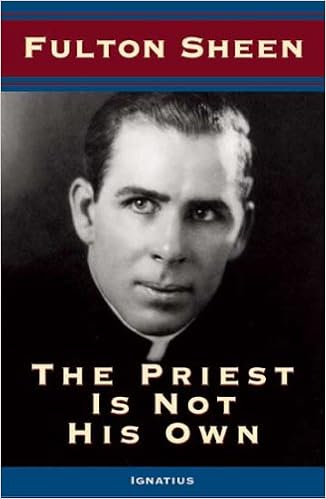
The Priest is Not His Own: An Overview


            I’ve always had an appreciation for the priesthood.  As a small child, I actually dreamed of becoming a bishop before hearing that I would not be allowed to marry.  However, while I have understood the basics of the priesthood, I wanted to get a greater understanding of its role, nature, etc.  So during a conversation with one of my priests from IU about the priesthood, he recommended the book “The Priest is Not His Own,” by future saint Archbishop Fulton J. Sheen, America’s second most famous televangelist (behind only Rev. Billy Graham).  The book was actually such an impressive overview of the priesthood that I felt a need to share it here.
            Now, it should be noted that this isn’t a traditional review like my previous ones.  In this case, I want to discuss the deeper implications and statements of Sheen as opposed to just saying what the book’s good or bad at.  So most of this will actually be aimed at discussing his points. Likewise, I finished this book a couple weeks ago so it has been a while since I’ve read it and I might not be as detailed as I should be.  However, I still wanted to share it here because this is a good book that deserves attention.
            The key to the priesthood is what calls him into the vocation.  The priest is defined as receiving a calling from God to perform his deeds, not acting out his own agency.  His work is God going through him, making the priest little more than a tool of God’s grace so that the Lord’s works may be done for the benefit of mankind.  There is much that must be done in promoting God’s work on this earth so he is the one that must perform that.
            In so doing, the priest is a reconnection between God and man.  Fulton Sheen described him as a literal Jacob’s ladder, allowing man a path towards heaven.  Man was after all separated from God in the Garden of Eden.  So the priest must perform the sacraments and duties of Christ, such as the Eucharist, which bring about that reconnection.  This makes him God’s agent.
            The key to performing this then is the rejection of the self.  The priest must reject the vices of the flesh and overcome his own brokenness.  He must continue to pursue a relationship with God above the moral vices of sin. This is of course what every person is called to as our duty as Christians is to become like Christ. However, the Priest must take this extremely seriously since that is his literal vocation.
            In so doing, sacrifice is a huge part of the priesthood.  The priest must forgo many things of this world in order to emulate his maker.  Suffering and pushing himself for his flock is a huge focus in the book.  He is essentially performing his own crucifixion as he sacrifices himself for God’s offspring.  In this way, becoming Christlike is his goal.
            Yet his humanity is also a huge part of his job.  It allows him to relate to his fellow man and go to them where they are. In this way, he can better connected to people and bring them to Christ.  Though not discussed in the book, this also allows different approaches to the priesthood and allows for more variety in addressing people’s needs. So this connection allows the priest to act as God’s tool yet still bring a needed individual approach.
            The final thing to review in the book is how it is written.  Fulton Sheen is an effective writer and gets his point across clearly.  He provides a lot of information in the book and it becomes easy to all take in.  He is a very good writer and knows a lot about the subject (duh!).  As a result, it makes the book a very effective presentation of the priesthood and its purpose.
            This is more of a Clift notes of the book as Sheen does go into a lot of detail. For that reason, I highly recommend reading it to get the full understanding of the priesthood. However, the overall points explain what the priesthood is and its role in the church, which should be brought to attention.  It simplifies the mystical and makes us better understand its significance.  It further solidifies why Sheen will most likely become a saint and the overall fundamental purpose of Catholicism: following Christ.