About This Blog

The purpose of my blog is mostly for review, film analysis, and other posts relating to popular culture. I always love to entertain and love to share the wonderful things I see. Join me on a journey through my life and the world
Showing posts with label Catholicism. Show all posts

Monday, November 22, 2021

Novena to Blessed Charles the Good


Repeat the following Novena every day for 9 consecutive days:


Let us begin, In the name of the Father, and of the Son, and of the Holy Spirit. Amen. 


O Blessed Charles the Good, whose love for God knew no bounds.  

You knew tragedy when you were young with the death of your father and yet never let that push you from God.  

You instead sought to serve him by working on behalf of the poor and the most vulnerable while rejecting the luxuries of the world.  

For this, you were martyred as you prayed and yet it did not change the good you did.  

I humbly ask that you pray for us now; that our own hearts may be open to God’s word and that we may may serve his creation, especially the most vulnerable, as you did.  I especially ask for (mention your request here…)


And for us to be made more in the image of Christ.

Amen.    


Our Father… 

Hail Mary… 

Glory Be…

Tuesday, August 18, 2020

Profiles in Heroism: St. Kateri Tekakwitha


  The United States has produced a number of prominent saints that went on to do the will of God.  However, there was one that was born on American soil before the concept of becoming an independent nation was even a possibility.  That would be Catholicism’s first native American saint from the US region, St. Kateri Tekakwitha, Lily of the Mohawks, patron saint of environment and ecology.

At a young age, Tekakwitha’s village was ravaged with smallpox which took her parents and her brother.  She was also afflicted with it and though she survived, she was given terrible facial scars that left her partially blind which resulted in her having to touch around to understand surroundings.  That is why she was given a name which means “She Moves Things.”

After losing everything, she was raised by her uncle who was a chief in the tribe.  She was horribly embarrassed by her facial scar and took to covering her face with a blanket.  In spite of that though, she still stayed involved in her village, diligently working where she “helped with the meals, collected berries from the woods, made baskets, did beadwork and strung the wampums.

Since her uncle was a chief, this put her in contact with three Jesuit missionaries who stayed with him when she was 11.  Listening to them, she found comfort in the words of Christ and became interested in Christianity.  It was not until she was around twenty though that she was baptized and then at 21 she took her first communion.  She then took on the name Kateri, which was the Mohawk version of the name Catherine as she took inspiration from St. Catherine of Siena.

From a young age, she had taken a disinterest in marriage and at the age of 19 had pledged herself to Christ and taken a vow of chastity.  This put her at odds with her family which put her decision at odds with her community.  As a result, she traveled to a different village with a larger Christian population.

Kateri was known for being particularly pious, dedicating herself to penance, fasting, and prayer.  As her life continued though, she became particularly ill and eventually died at the age of 24.  However, upon her death, witnesses say her scars disappeared and her face showed radiant beauty.

After her death, various visions of her appeared to different people.  Often these included healing after prayers dedicated to her.  As a result, she was eventually declared a saint by the Catholic church.

Kateri is a hero because she persevered despite the massive pain she faced.  Despite losing her family, she remained dedicated to doing good for those around her and helping those in need.  Her conversion is a reminder that in great pain, we often find comfort in the love of Christ.  So it is important that we remember her as a role model for overcoming our own pain and what truly doing good looks like.


Tuesday, May 29, 2018

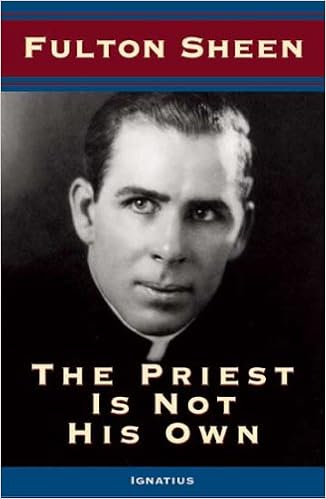
The Priest is Not His Own: An Overview


            I’ve always had an appreciation for the priesthood.  As a small child, I actually dreamed of becoming a bishop before hearing that I would not be allowed to marry.  However, while I have understood the basics of the priesthood, I wanted to get a greater understanding of its role, nature, etc.  So during a conversation with one of my priests from IU about the priesthood, he recommended the book “The Priest is Not His Own,” by future saint Archbishop Fulton J. Sheen, America’s second most famous televangelist (behind only Rev. Billy Graham).  The book was actually such an impressive overview of the priesthood that I felt a need to share it here.
            Now, it should be noted that this isn’t a traditional review like my previous ones.  In this case, I want to discuss the deeper implications and statements of Sheen as opposed to just saying what the book’s good or bad at.  So most of this will actually be aimed at discussing his points. Likewise, I finished this book a couple weeks ago so it has been a while since I’ve read it and I might not be as detailed as I should be.  However, I still wanted to share it here because this is a good book that deserves attention.
            The key to the priesthood is what calls him into the vocation.  The priest is defined as receiving a calling from God to perform his deeds, not acting out his own agency.  His work is God going through him, making the priest little more than a tool of God’s grace so that the Lord’s works may be done for the benefit of mankind.  There is much that must be done in promoting God’s work on this earth so he is the one that must perform that.
            In so doing, the priest is a reconnection between God and man.  Fulton Sheen described him as a literal Jacob’s ladder, allowing man a path towards heaven.  Man was after all separated from God in the Garden of Eden.  So the priest must perform the sacraments and duties of Christ, such as the Eucharist, which bring about that reconnection.  This makes him God’s agent.
            The key to performing this then is the rejection of the self.  The priest must reject the vices of the flesh and overcome his own brokenness.  He must continue to pursue a relationship with God above the moral vices of sin. This is of course what every person is called to as our duty as Christians is to become like Christ. However, the Priest must take this extremely seriously since that is his literal vocation.
            In so doing, sacrifice is a huge part of the priesthood.  The priest must forgo many things of this world in order to emulate his maker.  Suffering and pushing himself for his flock is a huge focus in the book.  He is essentially performing his own crucifixion as he sacrifices himself for God’s offspring.  In this way, becoming Christlike is his goal.
            Yet his humanity is also a huge part of his job.  It allows him to relate to his fellow man and go to them where they are. In this way, he can better connected to people and bring them to Christ.  Though not discussed in the book, this also allows different approaches to the priesthood and allows for more variety in addressing people’s needs. So this connection allows the priest to act as God’s tool yet still bring a needed individual approach.
            The final thing to review in the book is how it is written.  Fulton Sheen is an effective writer and gets his point across clearly.  He provides a lot of information in the book and it becomes easy to all take in.  He is a very good writer and knows a lot about the subject (duh!).  As a result, it makes the book a very effective presentation of the priesthood and its purpose.
            This is more of a Clift notes of the book as Sheen does go into a lot of detail. For that reason, I highly recommend reading it to get the full understanding of the priesthood. However, the overall points explain what the priesthood is and its role in the church, which should be brought to attention.  It simplifies the mystical and makes us better understand its significance.  It further solidifies why Sheen will most likely become a saint and the overall fundamental purpose of Catholicism: following Christ.

Sunday, May 27, 2018

A Film About Purgatory


(Spoilers)

            Religious symbolism and discussion has been very common in film.  From Boys Town to Les Miserables, faith and religion have played a part in some of the largest stories in Hollywood.  One overlooked film however that does touch on an actual greater truth is the movie Jacob’s Ladder.  There is a quote that does go on to discuss religion directly in the film, but the overall pretext actually does gives a pretty strong understanding of purgatory and letting go of the earthly self.  The film has provided a direct portrayal of what purgatory is like and the deep spiritual truth behind it.
             Jacob’s Ladder follows the story of Jacob Singer, a Vietnam veteran who has returned home despite being severely wounded during an attack in the war.  While doing his job as a postman in New York and living his day to day life, things seem to start changing oddly.  Throughout his daily adventures, weird evemts keep happening as his chiropractor’s office mysteriously disappears without a trace, is injured and then taken to a hospital where the people are severely misshapen, and he meets a man who claims the government experimented on him during the war, just to name a few of the crazy things he sees throughout his journey. All the while, he is being haunted by the memory of one of his sons who died before the war.  However, this all proves to be an illusion as he was actually mortally wounded in the attack at the beginning of film and at the end he finally accepts his death as he passes on into heaven.
            The film is loaded with symbolism and sets up its twist very well. Throughout the film, he is being told in several ways that he was dead the entire time, from a doctor in the hospital who is experimenting on him to a woman who reads his palm.  Meanwhile, misshapen creatures and strange occurrences keep appearing to commit odd acts on him from almost running him over to being some of the doctors working on him in the hospital.  At the same time, his girlfriend named Jezebel is trying to keep him moving throughout all these occurrences as though nothing is wrong. All of this keeps driving him to keep moving as he tries to find the answers to what’s going on that he needs.
            What’s going on is best explained by his chiropractor Louis.  As he notes:

“Eckhart saw Hell too. He said: ‘The only thing that burns in Hell is the part of you that won't let go of life, your memories, your attachments. They burn them all away. But they're not punishing you", he said. "They're freeing your soul. So, if you're frightened of dying and ... you're holding on, you'll see devils tearing your life away. But if you've made your peace, then the devils are really angels, freeing you from the earth.’”

As noted previously, Jacob was fatally wounded during the attack in Vietnam.  So throughout the film, he is desperately clinging onto life as the “monsters” he sees try to make him cope with the fact that he’s really dead.  Of course, Jacob fights this interpretation and clings to whatever he can of his old life to convince himself he’s still alive (including his girlfriend Jezebel, who in a deleted scene is revealed to be himself, representing the part of him that is trying to keep himself bound to this world). So the entire film is about angels preparing him for heaven while he desperately fights to stay alive.


            This is actually extremely close to the Catholic concept of purgatory.  The Catechism of the Catholic Church states:

"To understand this doctrine and practice of the Church, it is necessary to understand that sin has a double consequence. Grave sin deprives us of communion with God and therefore makes us incapable of eternal life, the privation of which is called the 'eternal punishment' of sin. On the other hand every sin, even venial, entails an unhealthy attachment to creatures, which must be purified either here on earth, or after death in the state called Purgatory. This purification frees one from what is called the 'temporal punishment' of sin. These two punishments must not be conceived of as a kind of vengeance inflicted by God from without, but as following from the very nature of sin. A conversion which proceeds from a fervent charity can attain the complete purification of the sinner in such a way that no punishment would remain.”

In simpler terms, upon death some souls will face a sort of punishment when they die.  This is designed to purify souls that are still in God’s light after death but have been bound to the earth by sin.  In the process, the soul is purified of these attachments and made pure so that it can enter into heaven.
            This is the plot of the film Jacob’s Ladder.  Throughout it, “creatures” or misshapen appear to Jacob and start stripping his life away, including telling him that he is dead and taking away parts of his life like his chiropractor’s office.  Naturally the human instinct is self-preservation, so this appears as terrifying to him.  Even in the face of God’s coming glory, his soul remains impure and attached to things on the earth.  However, like in purgatory he is eventually cleansed of these attachments as he accepts his fate and is taken to where he belongs.
            Overall, this further shows that inspiration can come from an unexpected source. Though likely not intentional, the film does serve as an appropriate allegory for purgatory.  It shows man’s fear of death, his need to release his attachments, and questions frail reality.  For this reason, it illustrates an eternal truth to be grasped. Inevitably, it can serve as a source of divine inspiration, even if that was not part of the idea behind it, just like with Frozen.